Wednesday, March 28, 2018

Genealogy Slam!


The spring genealogy program has undergone a transformation for 2018.

Instead of a Friday evening , we will be meeting on a Saturday afternoon during regular library hours. Same fun! Same refreshments! And yes, there will be DOOR PRIZES!

English Village
Photo by Olivier Collet on Unsplash
And we are very pleased to announce that we have Liz Pearson coming in to teach the basics of English and Welsh genealogical research.

Liz was born and brought up in England and has been sharing her expertise with northeast Ohio researchers for years!


And our own Lisa Rienerth will be explaining all the changes at FamilySearch.org and how to get the most from the new system!


Join us on April 28th at noon.   Sign up HERE.


Thursday, March 22, 2018

Julia Hach - a Tribute

1996 Plain Dealer
Women's History Month is March. And that means ALL women's history. Not just the famous or infamous, but everyone of us. With that in mind, I want to pay tribute to a local woman who was very outstanding in her own understated way - Julia Hach.


Julia was raised on the family's dairy farm, Waltona, south of Medina on Route 3. Waltona was known for its advanced farming practices and award winning Guernsey cows. Newspaper articles from the 1940's regularly listed the milk and cream output from the Hach family farm's cows. The pragmatism learned on the family farm guided Julia all her life.
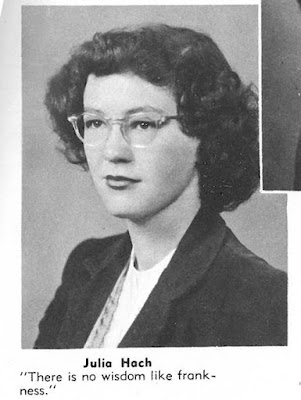
Medina High School Yearbook - 1949


Julia graduated from the Medina High School in 1949. From newspaper accounts and her yearbook listing, we find a young woman who was very active and very well rounded. She participated in 12 different clubs, including Glee Club, Choir, Orchestra, Band and Brass Sextet. I never knew that Julia was musical!


As a young woman coming of age during World War II, she dreamed of joining the Navy Nurses Corp. But she needed her father's permission and he refused to sign the papers.

Not to be deterred from her dream, Julia did become a nurse, going to school at the St. Luke's School of Nursing and later on the staff of St. Luke's, she worked her way to head nurse.

During her years of nursing, Julia also followed her love of animals, owning and raising standard-bred horses; trotter's and pacer's. Gazette articles from the 60's and 70's follow the success of her horses.

After retiring from the hospital, Julia worked for the U.S. Post Office, the Hinckley branch. In 1992, she retired for the second time.

It was around this time, the mid 1990's, that I made Julia's acquaintance when she came to the library to research her family history. Like all genealogists, we shared life stories and the proverbial "brick walls" of genealogy research. Julia learned of my service in the U.S. Air Force.

You see, Julia's biggest regret in life was that she had not served in her country's military forces. But she never lost her patriotism nor her admiration for women who had served. When the Women in Military Service to America Memorial was just a dream, Julia worked tirelessly as the Medina County field representative. She was among the thousands of women at its dedication in 1997.


Women in Military Service to America Memorial, Washington, D.C.

In the spring of 1997, Julia started contacting Medina County women who had served in the United States military. Her purpose was to compile their military biographies and donate the material to the local historical societies in order to document the contributions they had made to their country. That May, she gathered these women together to march in the annual Medina Memorial Day Parade, as they have done every year since then.

For most of these women, it was the first time that their service had been recognized.

In November 1999, many of these women veterans gathered to commemorate Veteran's Day together at a potluck luncheon at the Ohio National Guard Armory in Medina. After the luncheon, the women decided to formally organize as The Medina County Women of the Military.  Julia published the first of two volumes of Medina County Women of the Military from the compiled biographies. And she left behind enough material for the second volume


Besides forging a firm friendship, another life-changing development came out of our acquaintance. Julia connected me with my cousin Sharon Helmick Nicholson. One day, I was complaining about a "brick-wall" problem I was having with one of my ancestral lines. Julia asked which surname, to which I replied "Helmick". She told me that Sharon Nicholson, who I knew from the Military Women, was a Helmick. And I said, "Oh, but my Helmick's are from West Virginia. I said "Sure, right, Julia. Sharon and I are related." Several days later, Sharon showed up at the library with two big binders on her Helmick family. After studying it for some time, we determined that Sharon and I are fifth cousins, once-removed. And we have discovered that many of our family members share traits, such as a love for travel!

Medina Sun article from 25 May 2000. Julia is holding the flag. Cousin Sharon is right behind her.
All of these women are among the founding members of the Medina County Women of the Military.

Around this time, Julia became president of the Medina County Genealogical Society and she approached me about doing a series of genealogy classes at the library. We set it up and for several years she did a 6 class series for the Medina Library. The classes were always full. And her students were well prepared.

When Julia passed away in 2001, I took over the classes for one session. Even with all of Julia's handouts to work from, it was a huge task. And exhausting. But she had made it seem easy.

Julia would hate this tribute to herself. She never looked for attention or praise. She saw a job that needed doing and she did it.

But just like the military women whose service she recognized and documented, Julia deserves this recognition for ALL of her many contributions.

Julia L. Hach:
     Nurse
     Patriot
     Postal worker
     Horse raiser
     Genealogist
     Bird watcher
     FRIEND

SOURCES:
Cleveland Plain Dealer
Medina County Women of the Military Volume II, Medina County Women of the Military, 2005.
Medina County Gazette
     1 Jan. 2001
     6 Oct., 2001, p. A-2
Medina High School Yearbook - 1949
Medina Sun, 25 May 2000.

CHECK OUT THE COMMENTS FROM JULIA'S FRIENDS BELOW.

Thursday, March 8, 2018

New Beginnings..

It is nearly spring...


A time for new beginnings...


And a great time for babies!


A co-worker recently became a father for the second time - Congratulations, Dan & Katie!

This event inspired me to write about all the different ways we document the birth of a new child.

And of course, this means these are ALL the different resources we should be looking for...
  1. Early pregnancy test - Okay. This one is gross! I know, because my daughters told me so. But I actually saved the EPT stick from my second daughter. BTW, the color fades over the years. The "ick' factor can be eliminated by taking a picture of the test. Don't expect to find may of these.
  2. Gender reveal party - This is a relatively recent phenomenon, but it is possible that it is documented with invitations, photos, and a guest book.
  3. Ultrasound scans - Now, ultrasound scans are routine and expectant parents get copies to take home and share. First photo of baby? Probably an ultrasound.
4. Baby Showers - usually given shortly before the baby arrives, this tradition developed to help new parents defray the costs that come with a new baby. Invitations, pictures, guest books and possibly...

5. Baby books - Usually one of the gifts received at a baby shower, a Baby Book is an album just to document every moment of the young human's life. First food - listed. First BM -noted. Also includes a basic ancestry chart. Aunt Bonnie used to create quilted masterpieces.

Aunt Bonnie's quilted baby books are treasured heirlooms in our family.

6. Hospital pictures - These first photos are taken in the nursery in the hospital. Usually, you can purchase pre-printed birth announcements designed to hold these miniature photos.

Baby bracelet like the one pictured to below were used in the 1950's & 60's to make sure that mother & baby were correctly matched up when it came time to leave the hospital.

7. Hospital announcements - sometimes part of the "birthing" package at the hospital are paper birth announcements to send out to friends and family. Most hospital have moved to online pictures and announcements. Because of HIPAA and privacy concerns, most also require a password to access.

8. Mother's Certificate - a decorative birth certificate from the hospital. It is not an official government document and cannot be used in lieu of the official birth record. (see below)

While not official documents, Mother's Certificates can contain
information not found on the official birth certificate.

Did you know that footprints are also unique to the individual and can be used for identification?


9. Birth announcements - Commercial cards purchased and sent out by the parents.
10. Newspaper birth announcements - Aren't seen too often anymore, but local births used to be regularly published in the newspapers.

Birth announcements from a 1979 Peru, Indiana newspaper.
Privacy concerns have mostly eliminated such listings.
11. Birth record - The OFFICIAL birth record from the local government. In Ohio, it is registered with the local health department and the State Department of Vital Statistics. Did you know you can obtain a birth record for anyone born in Ohio after 1908 at your local health department? To learn more about how to do that, check out this BLOG POST.
12. Social Security Number - This should NOT be available for any living person. But you can often find a listing for deceased persons in the Social Security Death Index that is available on Ancestry Library Edition and FamilySearch.org.
13. Baptism/christening - These are ceremonial rituals of different religions. If the information is not in the family documents, you have to contact the church or parish where the ritual took place. 
Baptism records don't always give the date of birth, as this one does.
But prior to the government's requirement for official birth records, a
baptism record may be the closest you can find to a birth record.
14. Family Bibles - A family Bible that records all the births, deaths and marriages is a rare heirloom indeed. BUT, if all the handwriting is with the same pen and penmanship, it means it was filled out by one individual and probably not filled out at the time of the event. Then you are relying on the memory and accuracy of that one person.

These births were obviously all written at the same time by the same person.
IF that person was the mother, she would have first hand knowledge of the births.
But does she remember all the dates correctly?

Birth of  the first, second, or last child spurs some people's interest in researching their family's history; picturing sharing it with their children one day...

    Babies are such a nice way to start people.  - American humorist, Don Herold.


    Wednesday, February 28, 2018

    Extra! EXTRA! Read All About It!

    If you are geek like me, I have some exciting news!

    The Medina Library has just purchased several Wadsworth newspapers on microfilm.


    Masthead from the Wadsworth Enterprise


    What?!? You're not thrilled!

    Wait. You will be.

    First, how can you not love using newspapers for historical and genealogical research?

    In newspapers you can find information on your ancestors that you cannot find anywhere else. Sure, you can find birth, marriage and death notices. But you also find information about your ancestor's real estate sales, businesses (and the ads they put in the paper), out of town visitors, vacation plans, engagements and illnesses.

    Portage Sentinel 24 February 1847, page 4.
    William Tagg followed his father, James, into
    the painting and glazing business.


    Not too long ago, I found a notice where one of my relatives hosted the birthday party for his mother-in-law. It included a list of all the guests. A whole list of people that can now be added to my research plans.


    And when I was researching my 3X great-grandfather, James Tagg, I found a notice of his attendance at a GAR reunion. It told how the gathering was entertained by his stories from his Civil War ServiceApparently, he was a storyteller. Who knew?

    Excerpt from a larger article on the Reunion of the 91st O.V.I.
    Gallipolis Tribune 1 August 1894, page 3.


    Cleveland Plain Dealer 6 November
    1929, page 7. Clara was running for
    a seat on the Cleveland Board of
    Education. It was a position she
    held for the rest of her life.
    To learn more about online sites to do newspaper searches, look at this BLOG POST from 2 September 2015.

    Now, in Medina County, the type of news reported in the papers changed over time. The early papers, 1830-1866, mostly consisted of national and political news. Many of these early papers affiliated with a particular political party and their articles reflected a strong bias. But when you do find information on a ancestor or local resident, you cherish it even more.

    Some, like the one below, can fill in the gaps for a period when vital records are scarce or nonexistent.

    The Watchtower 1838.
    The notice gives us George MCCORMICK's birthday
    and his father's name. We know he was apprenticed
    to Noah BRONSON, who was an early settler of
    Medina and a judge from 1823-1830. We also know
    that George is sprightly and active and that Noah did
    not have a high opinion of George's father.

    Around 1870, more articles on local events and people start creeping into the paper. This trend continued until about 1960. Papers from the 30s, 40s and 50s, are FULL of social events that list everyone who attended and often describe the food served and the clothes worn. These details help give us insight into our ancestor's lives - the best of reasons to get excited about newspapers!

    And the Medina County District Library has never owned any of the Wadsworth newspapers on microfilm, until now.

    Here is the list:

    Medina Watch Tower – 1 reel
    Sep 12, 1838-Apr 14, 1841
    June 2 & 9, 1841
    Aug 4, 1841-Mar 2, 1842

    Wadsworth Enterprise
    – 3 reels
    May 4, 1866 to April 25, 1877

    Wadsworth News Banner – 26 reels
    Feb 3, 1910- Dec 29, 1955

    Wadsworth News – 6 reels
    Oct 30, 1920-Oct 6, 1932
    Feb 23-Sep 2828, 1933
    Nov 2, 1933 –June 29, 1944

    Now, besides the fact that Wadsworth is one of three cities within Medina County, what can we get out of these films?

    First, the Wadsworth Library has the obituaries in the Wadsworth newspapers indexed as part of the Ohio Obituary Project on the Rutherford B. Hayes Presidential Library and Museum website: http://www.rbhayes.org/  Access to more obituaries? That is always a good thing!

    Next, imagine how my blog on the Wadsworth Coal Mines could be impacted by having access to these Wadsworth newspapers. The post would probably contain a lot more detail than I was able to glean from The Gazette.

    AND...

    The 1876 editions of the Medina Gazette have always been MIA (Missing In Action). This is critical for two reasons that come immediately to mind.
    1. 1876 was the American Bicentennial. As Medina is celebrating its Bicentennial, wouldn't you like to know how the county celebrated the first U.S. Centennial in 1876? Me too!
    2. 1876 was the year the H.G. Blake died and for years local historians (including myself) have searched for his obituary. If you want to know who Blake was, read this POST.
    The Wadsworth Enterprise has its 1876 editions:

    The Wadsworth Enterprise 19 April 1876, page 4.

    NOW are you excited?  Me too!


    Saturday, February 24, 2018

    Gardener's Cottage


    Sadly, one of the historic Victorian buildings on South Court Street is in danger of collapse.


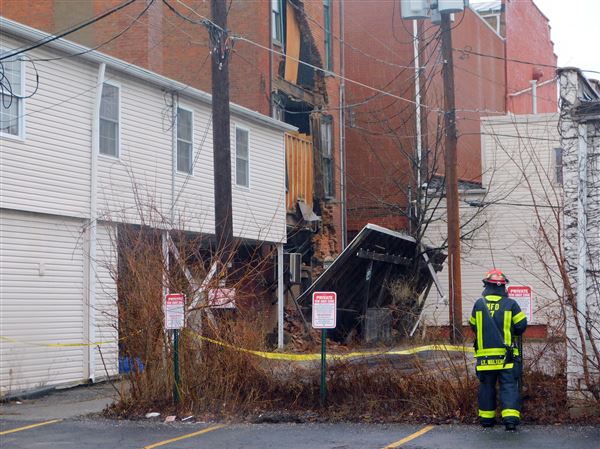
    236 South Court houses the Gardener's Cottage and early Monday morning, chunks of bricks fell off the back wall.


    As the official news continues to develop, I will add additional links here.

    WEWS coverage from 19 February:
    Gardener's Cottage Partially Collapses

    Gazette online from the 19th:
    Building Partially Collapses

    Picture of the back of the building from the February 21st Gazette  article.


    Late Tuesday, officials said that the building could  be saved.
    Gazette coverage from the 21st:
    Building is Salvageable

    On Wednesday, plywood was brought in to close off the front of the building so that traffic could be restored on South Court Street.


    Back of the building on Thursday, February 22, taken from second floor of the
    Medina Library. Photo courtesy of the author. You can see that some framing has
    been added and tarps are being installed to keep the rain out.

    The history of the building going back to the 1870's  can be viewed at the Medina Square website:
    East side of South Court Street. Look for the address 246 South Court.

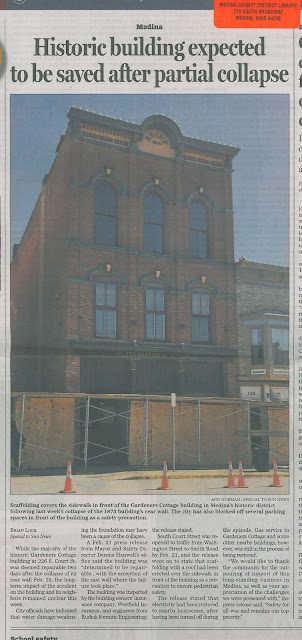
    Brunswick Sun Times 22 February 2018


    City of Medina Press Release:

    The Medina Post 24 February 2018.

    There have also been a lot of posts on Facebook about the building. Here is the business' FACEBOOK page.

    February 28, 2018 - All covered up and waiting for the reconstruction to begin!

    February 28, 2018 - taken from second story of the Medina Library.
    Today's Brunswick Sun News:

    Brunswick Sun News 1 March 2018.

    Thursday, February 22, 2018

    Medina's Tank Testing Ground

    In the midst of the Cold War, America was ramping up their military strength. Part of the that buildup was producing bigger, faster, better tanks. And what is now known as the IX Center, was in the 1950's, the site of the GM Cadillac Tank Plant, charged with building M41 Walker Bulldog tank.

    M41 Walker Bulldog Tank built at the Cadillac Tank Plant 1951-1954.
    Photo courtesy of Wikipedia. 
    While the tank was under production, GM needed a place to test the tanks that would reflect the rough areas they would need to travel during war conditions. An area near the Hinckley-West Richfield border was just what the company needed.

    In February 1951, Cadillac announced that the location, just off State Route 303, was ready for use and already had a tank on site. Called the Cadillac Ordnance Proving Ground, the site had everything needed to give the tanks a good work out: hilly terrain, deep ravines, switchbacks, dense brush and water hazards. Two test courses were designed to replicate field conditions.

    1958 Aerial Photograph depicting the Tank Proving Grounds.
    The spring rains were particularly effective in testing the tanks', and the drivers', abilities to maneuver through the muddiest conditions, as illustrated in this photo from the April 30, 1954 edition of The Medina Gazette.


    Medina Gazette,  April 30, 1954, page 1.
    The Army ceased production of the Walker Bulldog in 1955. A few years later, GM Cadillac turned over the tank plant to its Allison Division. They produced the M-551 Sheridan tank until 1972.

    Tank workers depicted in the December 3, 1965 newsletter for the Allison Division, called AllisoNews.
    They continued to use the Proving Grounds near Hinckley until 1970.

    AllisoNews photo of the proving grounds near Hinckley.
    By December of 1970, the Army had abandoned the site. Hinckley and Richfield Township officials worked together to obtain the land. It took until 1978 for the federal government to donate the land for recreational use.

    Named "Rising Valley Park", the two townships jointly operated the park from 1978 to 2005, when they decided to terminate the cooperative agreement. 44.7 acres went to Richfield and 188.3. acres became part of the Cleveland Metroparks.

    Rising Valley Park in Richfield Township.

    Rising Valley Park in Cleveland Metroparks.


    You can almost see the outline of the old tank testing grounds in this Google image.

    I see a field trip in my future!


    SOURCES:
    Aerial Photos - 1958- 1V- 169 in the Medina Franklin Sylvester Room Collection
    AllisoNews Newsletter Vol. XXV, No. 12, 3 December 1965, pages 1-2.
    Cleveland Metroparks - Rising Valley Park.
    Google Maps
    IX Center History
    Medina County Gazette
          "Hinckley Interested in Cadillac Grounds", 1 December 1970, page 1.
          "Hinckley Park Dubbed Rising Valley", 13 April 1978, page 1.
          "Tanks Get Mud Baptisms Near Hinckley", 30 April 1954, page 1.
          "Test Tanks at Hinckley", 27 February, 1951, page 1.
    Richfield Township - Rising Valley Park
    "M41 Walker Bulldog Tank" Wikipedia

    Thursday, February 15, 2018

    Wadsworth Coal Mines and Strike Breakers

    Coal was discovered and mined in Wadsworth Township as early as 1829. With the advent of train transportation, it became more profitable to extract the coal and starting in the 1850's coal mines popped up all over the area.

    One of the largest and most profitable of the mines was Silver Creek mines, owned by Erastus Loomis. Occasionally, the miners would go out on strike to pressure the owners to improve wages or working conditions. It was a common practice for the owners to bring in outside workers to take the striking miners' places. It was a cutthroat practice and it was effective.

    Map from Rogues Hollow History and Legends by Russell W. Frey
    showing the Silver Creek Mines (with red triangle)


    In 1880, the Wadsworth mine owners decided they would only pay the miners for the coal chunks that were a certain size. So they started screening each load of coal. The miners were not paid for anything small enough that it passed through the screen. The miners were being paid 50 cents per ton and they were expected to bring a certain tonnage of coal to the surface everyday. If they didn't meet their quota they would be considered a substandard worker and subject to being fired.

    Does this mean the owners threw out the smaller coal? Most certainly not! Smaller coal was still fine for home use and it would have been sold.

    The miners were incensed!  They were already being paid as little as .50 to $1 per day for the back breaking and dangerous work. Now part of their labors weren't even going to be measured! And the owners were making incredible profit! So they went out on strike!

    In her book, Medina County Coming of Age 1810-1900,  historian Joann King says that the strike started on April 14th of 1880. Curiously, I could not find any newspaper articles from that date about the strike. The Medina Gazette was silent on the topic, until later in the year.

    But as during past strikes, Erastus Loomis was looking for workers to take the place of the striking miners. However, he couldn't find enough workers locally. So he combed the black communities of the south. Soon, 200 Black men were unloaded from the train cars to work at the mine. Most were from Virginia.

    As they would have with any strike breakers, the miners threatened the Black men. Loomis responded by housing the men, and their families, behind a stockade.

    14 May 1880, page 7, Medina Gazette

    The county Sheriff called for help and Cleveland sent 25 deputies. When the threats continued, the Ohio Militia was sent to protect the strike breakers.
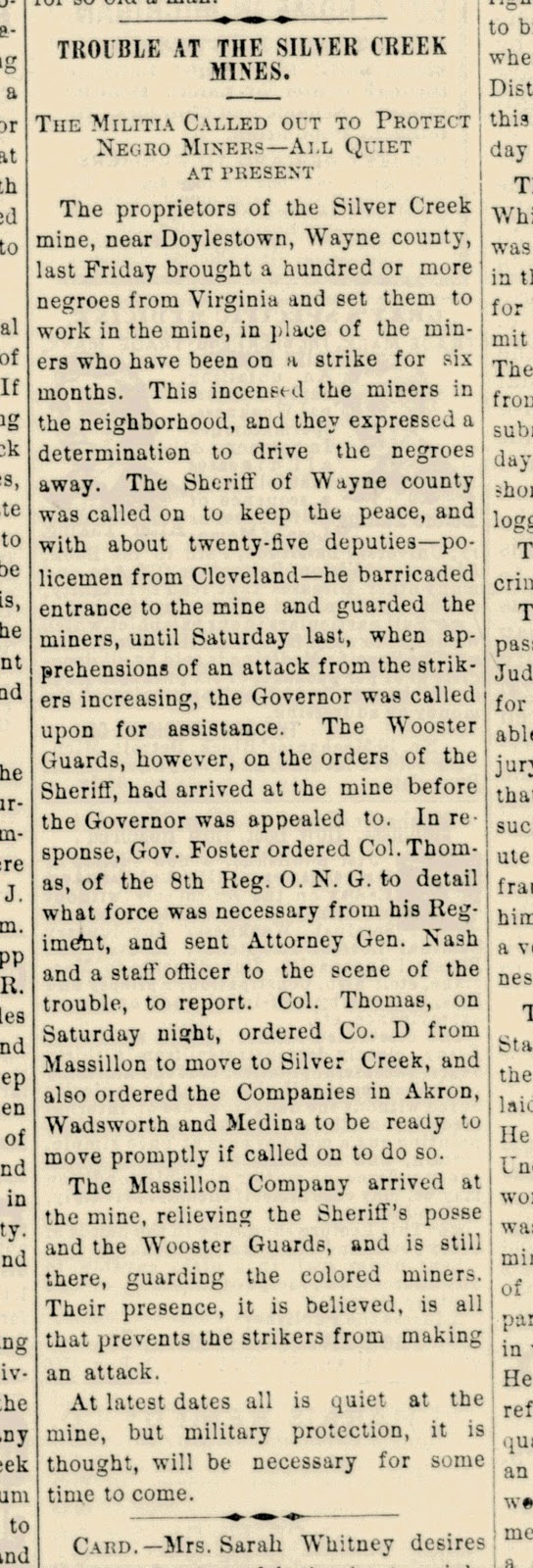
    14 May 1880  Medina Gazette, page 7


    In June, the strike was still on,  and the Black miners appreciated the presence of the Militia, believing their very lives depended on the soldiers.

    Medina Gazette 4 June 1880, page 7.

    Within two weeks the strike was settled and the miners went back to work. The militia was sent home.

    Medina Gazette  18 June 1880 page 7
    True to their word, after the militia left, a number of the Black miners also left. But a number stayed and settled in the Wadsworth area. Over the years, more strikes occurred and and more strike breakers were imported. And so more Black people settled in the Wadsworth area.

    A survey of the 1900 Federal Census for Wadsworth Township, shows of the 57 Black males living in the township, 35 were of working age. 27, or 3/4 of those men were miners.

    Around this same time, the children of the Silver Creek Black miners, were being taught by a "A colored woman from Massillon." (Joann King, Medina County Coming of Age, page 407).

    Soon after the families settled in, a Baptist Church was organized. Now known as the First Baptist Church, they hold annual reunions.

    Descendants of the Black coal miners first gathered in 1993.
    Sun Banner Pride, 2 September 1993.
    Sun Banner Pride 10 August 2000


    SOURCES:
    Medina County Coming of Age 1810-1900 by Joann King
    Medina Gazette:
          16 April 1880, page 7
          14 May 1880, page 7
          28 May 1880, page 2 and 7
          18 June 1880, page 7
     Remembering Wadsworth  by Caesar Carrino
    Rogues Hollow History and Legends  by Russel W. Frey
    Sun Banner Pride
         2 Sep 1993
        10 August 2000
    Wadsworth Center to City Eleanor Shapiro, editor
    U.S. Federal Census through Ancestry LE